The secret to growing a YouTube channel isn't really a secret at all. It boils down to one simple idea: create genuinely valuable content for a very specific group of people, and then make sure the YouTube algorithm can easily find it. This isn't about luck or going viral by chance; it's a science you can learn and repeat.
A Straightforward Blueprint for Fast YouTube Growth
Starting a channel feels like standing at the bottom of a mountain. Where do you even begin? This guide isn't a collection of vague theories; it's the playbook I've used and seen work time and again. We're going to focus on the things that actually move the needle, starting with carving out a hyper-specific niche that will attract die-hard fans.
Once you know who you're making videos for, we'll build a content strategy around solving their problems or feeding their passions. This ensures every single video you publish provides real value, which keeps viewers hooked and hungry for more. You’ll learn how to come up with video ideas that people are actually searching for and how to structure them to maximize watch time, a signal the algorithm absolutely loves.
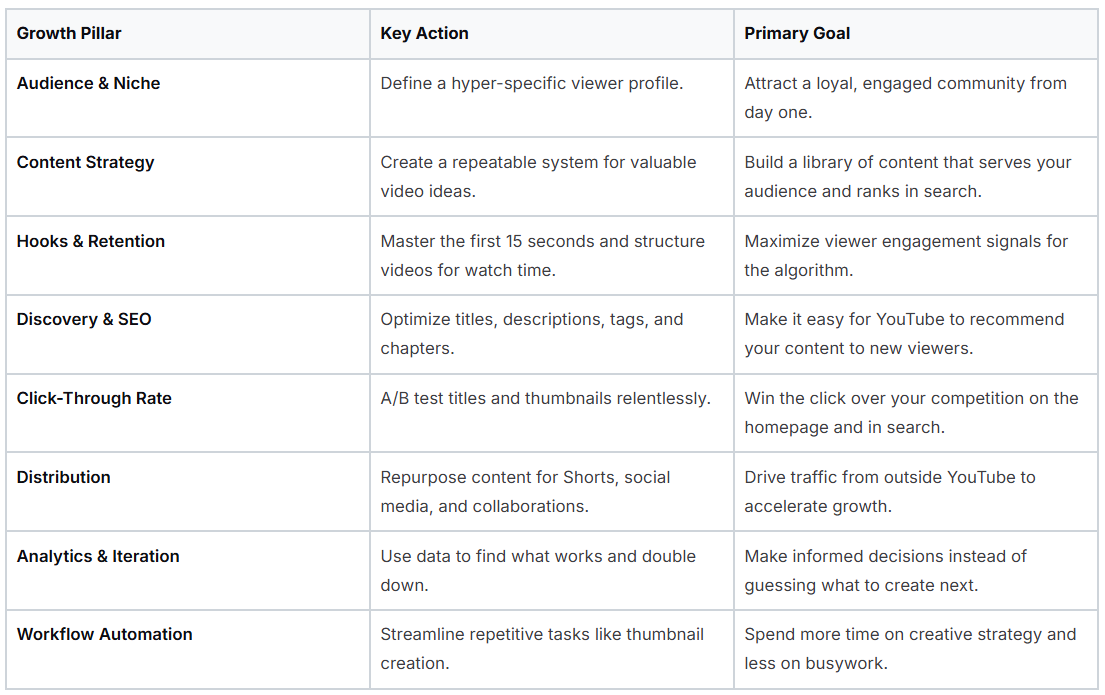
Before we dive deep, let's look at the foundational pillars that support any fast-growing YouTube channel. I've distilled the entire process into a simple table to give you a bird's-eye view of what we'll be covering.
Core Pillars of Fast YouTube Growth
Core Pillars of Fast YouTube Growth
Each pillar builds on the last, creating a powerful system for sustainable growth. Now, let's look at how these pieces fit together.
The Core Growth Framework
The journey from zero subscribers to a thriving channel follows a clear, three-stage process. This isn't just theory; it's a proven workflow that separates the channels that grow from those that stagnate. The flowchart below visualizes this strategy perfectly.
As you can see, figuring out your niche and content is the foundation. But optimization is the accelerator. It’s a constant feedback loop of creating, analyzing, and refining your approach.
The path to growing your channel isn't about one viral video. It's about building a system where every piece of content reinforces the others, creating a powerful engine for attracting subscribers.
It's also important to remember how far you've come. Hitting your first 500 subscribers puts you ahead of 58% of all channels, landing you in the top 42% of creators worldwide. Getting to 10,000 subscribers? You're now outpacing 94% of the competition.
These aren't just vanity metrics. They're signals to the algorithm that you're building a real audience. And nothing sends a stronger signal than a high click-through rate (CTR), with thumbnails often accounting for up to 90% of that performance. Channels that nail their thumbnail strategy see subscriber growth spike 3-5x faster. You can find more data like this in these fascinating YouTube statistics compiled by Hootsuite.
Finding Your Niche and Building a Content Strategy
Let's get one thing straight: if you try to be everything to everyone on YouTube, you'll end up being nothing to anyone. It’s a classic mistake. The secret to explosive growth is becoming the undisputed expert for a very specific group of people who share a common interest or problem. When you get this right, your channel becomes a magnet for the right kind of viewers.
Think about it. A channel about "cooking" is just noise. But what about a channel focused on "30-minute vegan meals for busy parents"? That’s not just a topic; it’s a solution. It instantly tells a specific person, "Hey, this is for you," making the subscribe button a no-brainer.
Find Your Unique Corner of YouTube
The sweet spot for a killer niche lives where three things overlap: what you love, what you know, and what people are actually searching for. You need all three. Passion is what gets you through the grind. Expertise is what makes people trust you. And audience demand? Well, that's what makes sure you're not just shouting into the void.
So, how do you find this magic intersection?
Your Passions: What could you talk about for hours? Seriously, what gets you so fired up you can't shut up about it? List out your hobbies and deepest interests.
Your Expertise: What do your friends always ask you for help with? Maybe it's a professional skill, a hidden talent, or something you've taught yourself inside and out.
Audience Demand: This is where you play detective. Head over to the YouTube search bar and start typing keywords from your lists. Pay close attention to what it auto-suggests. Those aren't just guesses; they are the exact phrases real people are looking for.
Once you’ve got some ideas, go a layer deeper. Don't just settle for a broad topic. Instead of "personal finance," what about "personal finance for freelance creatives"? That's a group with a ton of unique money challenges, and you can become their go-to resource.
Figure Out What Your Audience Really Wants
Okay, so you’ve got your niche. Now it’s time to become obsessed with the people in it. You need to understand their goals, their biggest headaches, and the questions they're asking better than they can articulate them. This is the secret sauce to making videos that feel like they were made just for them.
A great YouTube channel doesn't just upload videos; it solves problems. The problem might be boredom, a tricky skill, or a lack of inspiration. Your content has to be the answer.
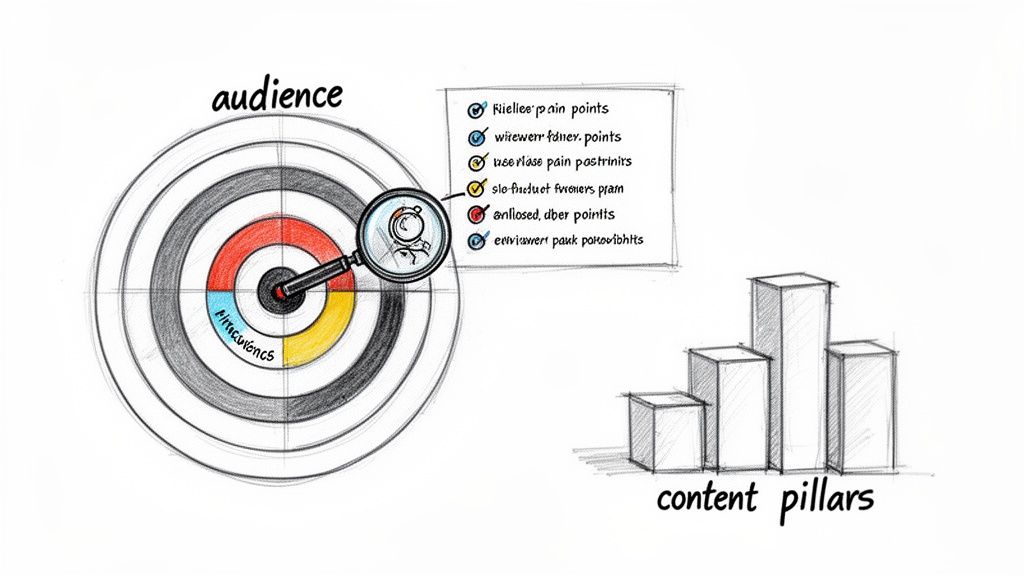
A powerful tool for this is the Value Proposition Canvas. It sounds corporate, but it’s a brilliant way to make sure your videos hit the mark every single time.
Viewer Pains: What are their biggest frustrations? For someone trying to become a home barista, this might be "bitter espresso" or "I can never get my milk foam right."
Viewer Gains: What are they dreaming of? For that same person, it’s probably "making café-quality lattes at home" or "impressing my friends with latte art."
Your Videos: Now, you just connect the dots. Your content becomes the pain relievers and the gain creators. You make a video titled, "3 Reasons Your Espresso Tastes Bitter (And How to Fix It)" or "The Only Milk Foaming Guide You'll Ever Need."
Suddenly, you’re not just guessing what to film next. You're strategically creating content that directly solves a viewer's problem, making your channel incredibly valuable and binge-worthy. This is the foundation for growing a YouTube channel fast.
Create a Content Plan That Lasts
With this deep audience knowledge, you can now build a content strategy that keeps you from burning out and gives you a nearly infinite well of video ideas. The trick is to create content pillars. Think of these as the 3-5 core themes your channel will always come back to.
Let's say your channel is all about "vintage synthesizers." Your pillars might be:
Synth Reviews: Deep dives into classic, iconic models.
Sound Design Tutorials: Breaking down how to create famous sounds from legendary tracks.
Maintenance & Repair Guides: Practical, hands-on tips for keeping old gear alive.
These pillars give your channel structure. On days when you feel totally uninspired, you just have to look at your pillars and brainstorm ideas within one of them. This keeps your content focused, builds your authority, and tells viewers exactly what they can expect from you week after week. They'll subscribe because they know precisely the kind of value you’re going to deliver.
Mastering Hooks, Retention, and Viewer Engagement
Alright, you've figured out your niche and have a solid content plan. Now for the make-or-break moment: getting people to actually watch your videos. Let's be real, the first few seconds of your video are the most valuable real estate you have. A viewer gives you maybe 15 seconds, if you're lucky, to convince them to stick around. Your intro is the gatekeeper.
The entire goal is to stop the scroll. You need a hook that yanks a viewer out of their passive browsing stupor and gives them a darn good reason to invest their time in your video. This isn't about cheesy clickbait; it's about making a clear promise and sparking immediate curiosity.
Crafting an Unskippable Hook
A truly great hook is a mix of psychology and raw strategy. It has one job: to instantly answer the viewer's unspoken question, "What's in it for me?" If that answer isn't crystal clear in a handful of seconds, they're gone.
Here are three hook formulas I've seen work time and time again:
The Problem & Promise: Hit them with a pain point they know all too well, then immediately dangle the solution. Think: "Are you sick of your houseplants dying? In this video, I'll show you the one simple watering trick that will keep them alive for good." It’s direct, relatable, and promises immediate value.
The Surprising Statement: Start with something bold, counterintuitive, or even a little shocking that flies in the face of common wisdom. A finance creator might open with, "Saving your money is actually making you poorer. Let me explain why." You can't help but want to know what they mean.
The Cold Open: Forget the intro and jump right into the action. If you're building a desk, don't start with you unboxing screws. Show a quick, slick shot of the finished masterpiece and say, "I built this amazing desk for under $100, and I'm going to show you exactly how."
These approaches work because they cut to the chase. They establish the video's value right away, which is absolutely crucial if you want to grow your YouTube channel fast.
Keeping Viewers Glued to the Screen
So, you hooked them. Great. The next battle is keeping them there. This is all about viewer retention, a metric the YouTube algorithm is obsessed with. High retention tells YouTube your content is genuinely satisfying, which means they'll show it to more people.
The secret is to constantly fight viewer boredom. A long, static shot of someone just talking is a retention killer. You need to jolt their attention with something new, a visual change, a sound cue, anything, every 15 to 20 seconds.
Think of your video not as one continuous shot, but as a series of mini-engagements. Every cut, B-roll clip, or graphic is another reason for the viewer to stay locked in.
Here are a few practical ways to do that:
Strategic Editing: Use jump cuts to slice out every "um" and awkward pause. Punch in closer to your face to emphasize a key point or switch to a different angle to reset their focus. Keep the pace brisk.
Visual Variety: This is non-negotiable. Weave in B-roll footage, screen recordings, relevant images, and on-screen text. If you mention a tool, show the tool. If you cite a statistic, put the number on the screen.
Sound Design: Don't underestimate audio. Subtle background music can completely change the mood, and simple sound effects can make your visuals pop. A little "swoosh" when a graphic appears makes a world of difference.
Turning Viewers Into Community Members
The final piece of this puzzle is turning those passive viewers into an active, buzzing community. Likes, comments, and subscribes aren't just for your ego; they're powerful signals to YouTube that your content is making an impact.
But just tacking on a robotic "Like, comment, and subscribe" at the end is lazy and, frankly, ineffective. You need to give people a reason to engage. Your call-to-action (CTA) should feel like a natural extension of the video.
Instead of a generic outro, try asking a specific question that ties directly back to your topic. If you just made a video about fixing bitter espresso, you could end with, "What's the biggest coffee mistake you've ever made? Drop it in the comments below. I'd love to hear your stories." This invites them into a conversation and makes them feel like part of something, not just another view count.
Dominating YouTube SEO for Maximum Discoverability
Let's be real: you can make the best video in the world, but it’s worthless if no one ever sees it. You have to stop thinking of YouTube as just a video-sharing site. It's the second-largest search engine on the planet, right behind Google. If you want to get found, you have to learn to speak its language.
That's where YouTube SEO comes in. It's all about giving the algorithm a crystal-clear roadmap to your content. When you optimize your video, you’re telling YouTube exactly what it's about, who it’s for, and why it's the perfect answer to a viewer's search. This is the secret to generating consistent, organic traffic that brings in views for months, or even years, after you hit publish.
Finding the Right Keywords
Keyword research is ground zero. This is where you figure out the exact words and phrases your ideal viewer is typing into the search bar. The sweet spot is finding topics with decent search volume but beatable competition, giving your video a fighting chance to rank.
A surprisingly powerful way to start is right in the YouTube search bar itself. Type in a broad topic related to one of your content pillars, something like "beginner guitar lesson," and just watch what YouTube suggests. Those autocomplete options aren't random; they're based on what real people are actively searching for. It’s a direct line into your audience's mind.
To get more advanced, tools like TubeBuddy or VidIQ are invaluable. These browser extensions overlay search volume and competition data directly onto YouTube, helping you uncover hidden gems that other creators have overlooked.
Writing Titles That Demand a Click
Your title has a dual purpose: it must satisfy the algorithm with a core keyword, and it has to pique a human's curiosity enough to earn a click. A killer title makes a clear promise and often sparks a little bit of urgency or intrigue.
Let's look at the difference.
Boring: "My Video on Beginner Guitar Chords"
Optimized: "The 5 Guitar Chords Every Beginner Actually Needs to Know"
The second one just hits differently, right? It targets the keyword ("beginner guitar chords"), uses a number to grab your eye, and creates a sense of insider knowledge. It promises a shortcut, making it far more compelling. Getting this right is a huge piece of the puzzle, and you can dive deeper into creating effective titles and tags in our detailed guide.
Your title and thumbnail are a one-two punch. The thumbnail is the hook that grabs their attention in a sea of options. The title is the confirmation that your video is the answer they’ve been looking for. They have to work together perfectly.
Crafting a Powerful Description
So many creators treat the video description as an afterthought, and it’s a massive mistake. Think of it as your secret weapon for SEO. It’s where you can provide rich, detailed context that helps the algorithm understand your video on a deeper level and rank it for a whole host of related search terms.
A well-written description should always have these components:
A Compelling Opening: The first 2-3 sentences are critical because they show up under your video in search results. Restate your main keyword here and write a snappy summary that highlights the value a viewer will get.
Detailed Explanation: Don't stop there. Use the rest of the space to write a few conversational paragraphs that naturally weave in your primary and secondary keywords. Think about related questions your audience might have and answer them here.
Timestamps (Chapters): Breaking your video into chapters with timestamps isn't just great for the viewer experience. It also allows Google to show specific sections of your video directly in its search results, giving you even more chances to be discovered.
Relevant Links: Always include links to your website, social media profiles, and other relevant videos on your channel. This keeps people in your ecosystem longer.
The Art of Using Tags Effectively
Tags are another signal you send to YouTube about your video's content. While they aren't as heavily weighted as they used to be, they still play a role in discovery, especially for newer channels trying to gain traction.
A good strategy is to think of them in a hierarchy, from super-specific to more general.
Specific Tags: These are your long-tail keywords that perfectly describe the video. For a video on fixing a dripping sink, a specific tag would be "how to fix a leaky kitchen faucet."
Broad Tags: These give the algorithm broader context. For that same video, you'd use tags like "home repair," "plumbing," and "DIY."
Using a mix of both helps YouTube pinpoint your video's core topic while also understanding the broader category it belongs to. This lets the algorithm show your content to a wider, yet still relevant, audience.
Creating Thumbnails That Demand to Be Clicked
If your title gets a potential viewer to the door, your thumbnail is what makes them turn the handle. Think of it as your video's billboard in a sea of endless scrolling. It has to grab attention, promise value, and spark curiosity in a split second.
Honestly, the thumbnail often does more of the heavy lifting than the title itself. It’s not just a random screenshot; it's a carefully crafted piece of marketing designed to pop, especially on a tiny mobile screen. This is your single best shot at winning the click.
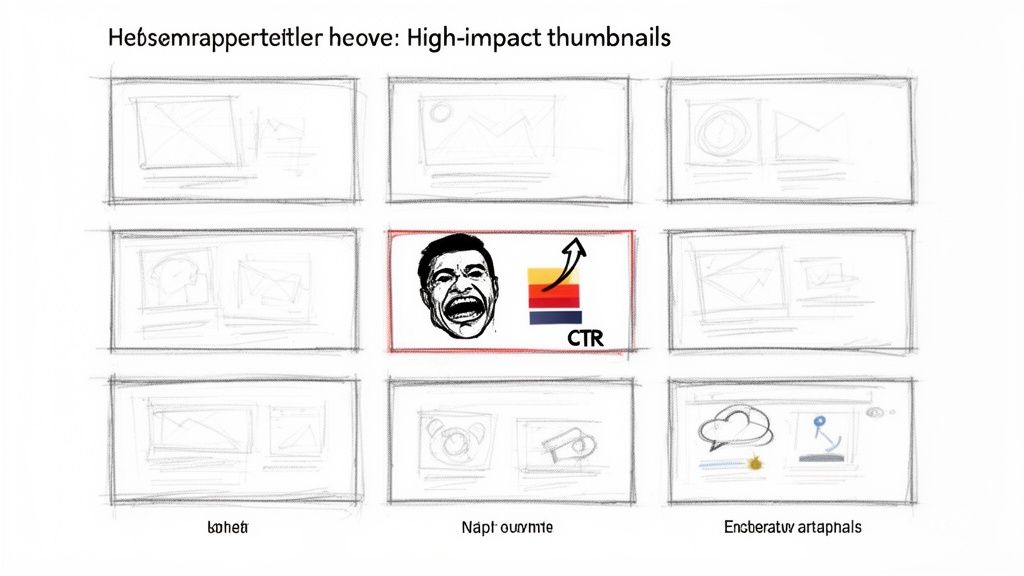
The Anatomy of a High-CTR Thumbnail
The best thumbnails tap into a few core psychological triggers. They aren't complicated, but they are incredibly intentional. Once you understand them, you can start creating designs that consistently beat out the generic, low-effort stuff.
Strong Emotional Expressions: Human faces are attention magnets. A clear expression, like surprise, joy, or frustration, creates an instant connection. It makes people need to know the story behind that reaction.
Contrasting Colors: Your thumbnail has to fight for visibility against YouTube's interface. Use bright, bold colors that clash in a good way. Think vibrant yellows against deep blues or electric greens against red. You want it to be impossible to ignore.
Minimal, Powerful Text: Less is more. Aim for 3-5 words that add intrigue or highlight a key benefit. The text should complement the image, not just repeat the title. Think "IT WORKED!" or "SECRET FOUND."
Clean Branding: Consistency helps your subscribers spot your content instantly in their feed. A small, subtle logo or a consistent color scheme acts as a familiar signal.
Nailing these fundamentals can dramatically improve your click-through rate. For a more detailed breakdown, check out our guide on essential YouTube thumbnail tips.
Your Secret Weapon: A/B Testing Thumbnails
So you’ve made a great thumbnail. But is it the best one? Guessing is a painfully slow way to grow a channel. This is where A/B testing becomes a game-changer. The idea is simple: create two different thumbnail options for the same video and let the data tell you which one people actually click on.
A 1% bump in your click-through rate might not sound huge, but on a video with 100,000 impressions, that’s an extra 1,000 views. Over time, those small wins compound into massive channel growth.
You can isolate and test different elements to see what truly connects with your audience.
Test Expressions: Does a shocked face outperform a smiling one?
Test Text: What happens if you add text versus having none at all?
Test Colors: Pit a bold red background against a cool blue one.
By systematically testing and picking the winner, you're constantly feeding the YouTube algorithm positive signals. A higher CTR tells YouTube your content is compelling, which makes the algorithm show it to more people. It’s a powerful feedback loop that’s absolutely critical for growing fast.
Standing Out in the Vertical Feed
This isn't just for long-form video. The same principle is supercharged for YouTube Shorts. With Shorts now pulling in over 70 billion daily views from 2 billion monthly users, the vertical feed is a massive discovery engine.
And get this: data shows that the thumbnail can be responsible for 60-80% of a Short's initial engagement. Tools like Thumbnail Maker can automatically pick out the most engaging frames and create different options for you, helping creators boost their CTR by an average of 30%. You can dig into more impressive YouTube statistics to see the full picture. The takeaway is clear: optimizing your visuals for the vertical feed is just as important as it is for your main channel content.
Smart Distribution and Promotion Strategies
Hitting "publish" is just the start. If you want your channel to grow, and grow fast, you can't just cross your fingers and hope the algorithm finds you. You need a distribution plan to give your content that initial push and get it in front of people who aren't already subscribed.
Think of your main video as the feature film. Your promotion is the trailer, the poster, the buzz. It's everything that makes people want to show up. It’s all about creating as many doors as possible that lead back to your best work.
Unleash the Power of YouTube Shorts
YouTube Shorts aren't just a side project anymore; they're a massive discovery tool. A single, well-made Short can put your channel on the map for thousands of new people who would have never stumbled upon your longer videos. The real goal isn't just views, it's turning those viewers into subscribers.
The most effective way to do this is to treat Shorts as powerful teasers for your main videos.
Clip Your Best Moments: Pull out the most shocking, funny, or insightful 30-60 second bite from your long-form content. It needs to be compelling on its own but leave the viewer hungry for the rest of the story.
Add a Clear Call-to-Action: Use on-screen text or a pinned comment that points directly to the full video. A simple "Full breakdown in the linked video!" does the trick.
Repurpose with Purpose: You don’t have to create Shorts from scratch. Tools that automatically create short cutdowns from your main video can save you countless hours and keep a steady stream of vertical content flowing.
This strategy creates a direct funnel, guiding casual Shorts scrollers to become engaged viewers of your long-form content and, ultimately, loyal subscribers.
Cross-Promote Your Content on Other Platforms
Your audience isn't only on YouTube. They're scrolling through Instagram, TikTok, LinkedIn, and X (formerly Twitter). Sharing your content on these platforms is a must, but just dropping a link and walking away won't cut it. You have to adapt your message to fit the vibe and format of each platform.
Don't just spam your video link everywhere. Create native content for each platform that teases the value of your full YouTube video. You're not just promoting; you're starting a conversation.
Let’s say you made a 10-minute video on "The Best Budget Laptops for Students." Here’s how you could chop that up:
Instagram Reel/TikTok: A snappy, 30-second video showcasing the top three laptops with quick cuts and trending audio.
LinkedIn Post: A text-focused post discussing how processing power impacts student productivity, featuring a great photo of a laptop and a link to your full review.
X (Twitter) Thread: A thread that breaks down one key tip from your video, like "How to Check a Laptop's Battery Health Before You Buy."
Each piece of content offers real value on its own while pointing back to your main YouTube video as the go-to resource.
Engage in Relevant Communities Authentically
Another killer tactic is to become a known, helpful voice in the online communities where your audience already gathers. This could be specific subreddits, Facebook groups, or niche forums. The golden rule here is to give value first and promote second.
Nobody likes a link-spammer. Instead, jump into discussions, answer people's questions, and build a reputation as someone who knows their stuff. Then, when it's genuinely relevant, you can share your video as a resource to help solve a specific problem.
For example, if someone in a home-brewing subreddit asks why their latest batch tastes off, and you happen to have a video troubleshooting that exact issue, sharing the link is helpful, not spammy. This approach builds trust and drives highly-qualified, interested viewers straight to your channel.
Common Questions About Growing on YouTube
When you're starting out, it's easy to get bogged down with questions about how YouTube really works. I've heard the same ones from countless creators, so let's cut through the noise and get you some straight answers.
Getting these fundamentals right will help you set realistic goals and put your energy where it actually counts.
How Long Until I Actually See Growth?
Look, there's no magic switch to flip. But from what I've seen, most channels start to get real, meaningful traction after consistently uploading high-quality, optimized videos for about 6 to 12 months.
Consistency is everything here. You can't just upload a flurry of videos in one month and then go silent. The algorithm needs a steady stream of data to figure out who your audience is and start pushing your content to them.
Your initial goal should be to build a solid foundation. Aim for a library of at least 15-20 videos that clearly show what your channel is all about. This gives YouTube enough material to work with and start finding your people.
Don't panic if you're not a viral sensation in the first few months. Real, sustainable growth is a long game. Concentrate on making each video better than the last, and the audience will come.
How Often Should I Be Posting?
When you're new, a great starting point is one high-quality video per week. For most people, this is a realistic and sustainable pace. It keeps your channel active and gives the algorithm fresh content to test without leading to burnout.
And let’s be clear: quality beats quantity every single time. It's far better to publish one amazing, well-thought-out video than to churn out three rushed, mediocre ones.
Once you nail down your process and can produce great content efficiently, you can think about upping the frequency. But never, ever sacrifice quality to get more videos out.
Is It Worth Paying for Promotion?
Using tools like Google Ads to promote your videos can definitely get you an initial spike in views, but it's usually not the best move for a new channel. Why? The viewers you attract through ads are often just passing by; they don't stick around, which can hurt your watch time and audience retention signals.
Honestly, your time and money are better spent mastering organic growth. Get really good at making incredible content, dialing in your SEO, and designing thumbnails that people can't resist clicking. Those skills will pay dividends for the entire life of your channel, a much better return than any temporary ad campaign.
Ready to create thumbnails that get more clicks and speed up your entire publishing workflow? Thumbnail Maker uses AI to generate high-impact designs, titles, descriptions, and Shorts in minutes. Stop guessing and start growing. Try Thumbnail Maker for free and see the difference.
Learn how to write a script for a YouTube video with this complete guide. Get actionable tips and frameworks to craft scripts that boost views and retention.
Learn how to make good YouTube thumbnails with this guide on design, psychology, and strategy. Boost your CTR and get more views with proven techniques.